Tous les forums
raté!!!

23/01/2008 à 16h08
sbire Ecrivait:
-------------------------------------------------------
> Malgrés un traitement qui me convenait, un an
> aprés, surprise (désagréable). Comme quoi....
>
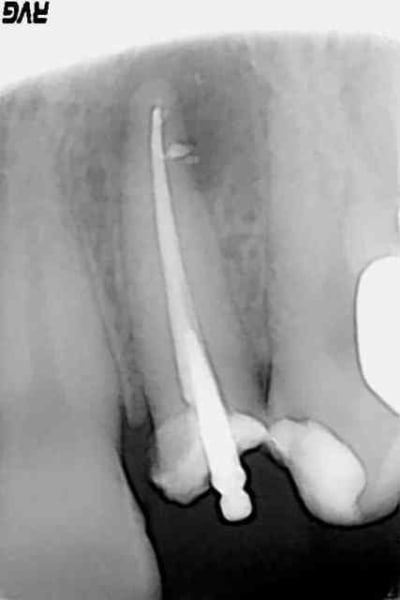
> j'ai apparement raté un canal accessoire...
hier dépose ic+ccm : 1 heure
reprise de ttt la semaine prochaine...la patiente a eu un épisode infectieux impressionnant la semaine derniere
les radios du resultat la semaine prochaine
24/01/2008 à 15h19
olivier d Wrote:
-------------------------------------------------------
> En réponse à Stéphane , l'utilisation du glyde en
> endo mécanisée est très utile pour diminuer les
> risques de fractures d'instruments avec les
> protaper. En effet la boue dentinaire agit comme
> un coin dans les stries du métal ( à ne pas
> confondre avec les spires ) .Il est par contre
> moins utile avec des instruments qui ont reçu un
> traitement de surface.
Juste pour information : une petite lecture de cete abstract te montrera que les idees recues ne sont certianement pas les meilleurs. dansle meme article, ils demontrent tout et son contraire, comme quoi. en l'occurrence, avec le protaper, le Glyde n'a aucun interet... Da'illeurs tu te contredis tout seul, puisque aujourd'hui tous les instruments ont recu un traitment de surface a la fabrication; les proatepr les premiers...
1: Int Endod J. 2005 Apr;38(4):223-9.
Effect of liquid and paste-type lubricants on torque values during simulated
rotary root canal instrumentation.
Peters OA, Boessler C, Zehnder M.
Division of Endodontology, Department of Preventive Dentistry, Periodontology,
and Cariology, University of Zürich Center for Dental Medicine, Zürich,
Switzerland.
AIM: To evaluate the effects of lubrication on torque generated during rotary
preparation of simulated root canals in dentine using ProFile and ProTaper
Nickel-Titanium instruments. METHODOLOGY: Thirty-two 3 mm thick dentine discs
were used for this study. Four pilot holes were drilled perpendicularly through
each disc. These simulated root canals were filled with water, aqueous 15%
ethylenediamine tetraacetic acid (EDTA) or a paste-type lubricant (Glyde). Empty
canals served as controls. Peak torque values and apically directed forces of
rotary instruments were measured using a specially designed testing platform.
Full torsional loads over time were calculated by integration of continuous
torque records. Data were compared using analyses of variance with the alpha-type
error set at 0.05. RESULTS: Maximum torque values using ProFile instruments were
significantly (P < 0.005) reduced by the EDTA solution, whilst no reduction was
observed using Glyde. With ProTaper instruments, no lubricant effects on maximum
torque values were observed (P = 0.372). Full torsional loads over time were
significantly reduced for both ProFile and ProTaper preparation (P < 0.005) by
the use of lubrication. The two fluids performed significantly better than
paste-based Glyde. All lubricants reduced force when applied to ProTaper by mean
reductions ranging from 12 to 54%, whilst Glyde lead to increased force when
applied to ProFile. CONCLUSIONS: Under the conditions of this laboratory study,
lubrication appeared to be advantageous. Aqueous solutions generally performed
better than the paste-type product under investigation, which showed untoward
effects when used in conjunction with a rotary instrument with a U-shaped
25/01/2008 à 23h13
Et sinon Stéphane, ça t'arrive de dormir ?
Ou alors tu sèches tes vacations de clinique pour squatter dans la bibliothèque de birmingham ? :-)